Tassos Kolydas presenter a paper at the 8th Conference of the Greek Society for Music Education, entitled Digital Scores: Selecting Software for Teaching Music in Greek Public Schools
Digital scores provide valuable support to music teachers, either as aids for lesson design and implementation or as products of the educational process. From teaching music notation to supporting school musical events, a digital score is a consistent part of a music teacher’s efforts. Factors related to day-to-day classroom management are taken into account along with factors including equipment availability, financial resources for the acquisition of hardware and software, increased teacher workloads, and teaching in multiple schools. Since learning a score editing program involves a steep learning curve, software selection must be undertaken with care to ensure that it offers long-term benefits to both teachers and students.
All things considered, it can be safely deduced that FOSS is the best choice for the Greek educational system.
Tassos Kolydas, Digital score as a historical source for recording music heritage; challenges, opportunities, perspectives
Music scores are a valuable kind of source for recording and studying music culture heritage. In particular, music manuscripts provide rich and diverse information; besides the musical content, they provide evidence for the conditions of creation of the musical work (corrections, additions and removals of material), composition (sketches, revisions, final version), identification of the work and the composer (creation date, original-copy distinction, writer's handwriting), etc. The ability to edit sheet music using a computer brings new possibilities, gradually establishing digital score as the best way to write music. On the other hand, most of the mentioned information are missing from the digital score. The purpose of the announcement is to examine the challenges, opportunities, perspectives which occur from the study of the digital score.
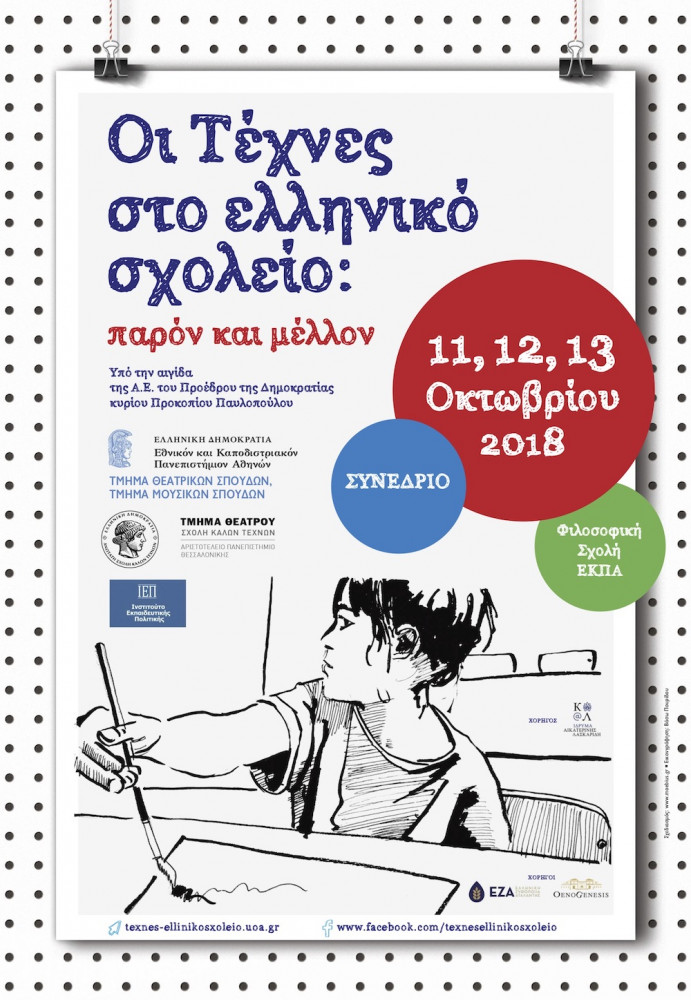
A three-day conference titled The Arts in the Greek School: Present and Future was organized by the Department of Theater Studies and the Department of Music Studies of the School of Philosophy of the National and Kapodistrian University of Athens, the Department of Theater of the School of Fine Arts of the Aristotle University of Thessaloniki and the Higher School of Fine Arts, and collaboration the Institute for Educational Policy of the Ministry of Education. The conference took place on October 11, 12 and 13 of 2018.
Publications
- Tassos Kolydas, “Classical guitar in Greece during the second half of the twentieth century: aspects of the transformation of a musical instrument from the repertoire point of view”, 9th Interdepartmental Musicological Conference entitled "Variations, arrangements, transformations", Hellenic Musicological Society, Thessaloniki 2021. [pdf, more]
- Tassos Kolydas - Nick Poulakis, “From handwritten sheet music to digital notation: Exploring the way Greek Composers compose their works using digital score”, 11th Interdisciplinary Music Conference, «Innovation and Tradition (commemorating the 70th anniversary of Nikos Skalkota's death)», (under the auspices of the Hellenic Music Society, Athens, November 21-23, 2019), Athens 2020. [pdf, more info]
- Tassos Kolydas, “Timestamping Metadata Using Blockchain: A Practical Approach”, Emmanouel Garoufallou, Francesca Fallucchi & Ernesto William De Luca (ed.), Metadata and Semantic Research. MTSR 2019. Communications in Computer and Information Science, 1057, Springer, Cham, 2019. [pdf, more info]
- Tassos Kolydas, “Digital score as a historical source for capturing musical heritage; challenges, opportunities, prospects”, 10th Interdepartmental Musicological Conference: “The musical heritage in Western art music”, (Proceedings of the Interdepartmental Conference under the auspices of the Hellenic Music Society, Corfu, 26-28 October 2018), Hellenic Music Society, Thessaloniki 2019. [pdf, more info]
- Tassos Kolydas, “Digital score: selecting software for teaching music in the Greek public school”, D. Koniari & T. Raptis (ed.), Music Education and Society: new challenges, new orientations. GSME 8th conference, GSME, Thessaloniki 2019, pp. 204-211. [pdf, more info]
- Tassos Kolydas, Dimitri Fampas (1921-1996): a pioneer of the Greek Guitar School, (Hellenic Musicological Editions) Athens, 2017, Panas Music. [more]
- Tassos Kolydas, “Digital literacy and music: an approach to beliefs about quality, regarding lossy algorithms for compressing audio signal”, 7th Conference of G.S.M.E.: Music Literacy / Formal and informal ways of music teaching - learning, Thessaloniki, 2016. [pdf, more info]
- Tassos Kolydas, “The repertoire of the Philharmonic Orchestra of New York, conducted by Dimitri Mitropoulos”, Dimitri Mitropoulos (1896-1960): 50 years later (Conference proceedings, edit. I. Fulias, I. Belonis, G. Vlastos, T. Kolydas), Athens, 2011, Orpheus ed., p. 204-216. [more]
- Haris Sarris – Tassos Kolydas – Michalis Kostakis, “Investigating instrumental repertoire following the technique of parataxis: A case study”, Journal of Interdisciplinary Music Studies - JIMS, Ismir, 2010, 4/2, p. 99-120. [pdf, more]
- Haris Sarris – Angelos Velegrakis – Tassos Kolydas, “Drawing a parallel between the gaida (bagpipe) and the Zonarádikos line dance through statistics”, Journal of Interdisciplinary Music Studies - JIMS, Ismir, 2010, 4/2, p. 121-142. [pdf, more]
- Tassos Kolydas, “Entrusting the leading role to the guitar for the performance of incidental music during the first postwar period; a historical – musicological approach”, Conference proceedings: Greek music for the opera and other forms of the performing arts in the 20th century, Athens, 2010. [pdf, more]
- Haris Sarris – Tassos Kolydas – Panagiotis Tzevelekos, “Parataxis: A Framework of Structure Analysis for Instrumental Folk Music”, Journal of Interdisciplinary Music Studies - JIMS, Ismir, 2010, 4/1, p. 71-90. [pdf, more]
- “The 'weak' sound of the guitar and Andrés Segovia being its 'attendant'”, Tar Guitar Journal, 2007. [pdf, more]
- Tassos Kolydas, “First strides in the performances of guitar concertos in Greece”, tar.gr, 2007, http://www.tar.gr/en/content/content.php?id=373. [pdf, more]
- “The transformation of the guitar’s repertoire in the early twentieth century”, Polyphonia, Athens, 2006, i. 9. [pdf, more]
Conference Papers
- Tassos Kolydas, "Research and teaching in the digital context: findings and perspectives from the use of digital documents in music", 12th Interdepartmental Musicological Conference, Thessaloniki 2020
- Tassos Kolydas, “Locked in time: Utilizing blockchain technology for the long-term preservation of engraved music”, Music Engraving in the 21st Century – Developments and Perspectives, (Mozarteum Music University in Salzburg, Austria, 17-19/1/2020), 17/1/2020, https://www.uni-mozarteum.at/en/kunst/music-engraving-conference.php, (last access: 22.1.2020).
- Tassos Kolydas - Nick Poulakis, “From handwritten sheet music to digital notation: Exploring the way Greek Composers compose their works using digital score”, 11th Interdisciplinary Music Conference, «Innovation and Tradition (commemorating the 70th anniversary of Nikos Skalkota's death)», (under the auspices of the Hellenic Music Society, Athens, November 21-23, 2019), Athens 2019.
- Tassos Kolydas, “Timestamping Metadata Using Blockchain: A Practical Approach”, MTSR 2019, Rome 2019.
- Tassos Kolydas,“Using blockchain technology for preserving digital documents in music libraries and archives”, 3rd Conference of Greek Music Libraries and Archives, Thessaloniki, 11/05/2019
- Tassos Kolydas, “Digital score: selecting software for teaching music in the Greek public school”, Music Education and Society: new challenges, new orientations, (GSME, 8th conference), Thessaloniki, 24/11/2018
- Tassos Kolydas, “Digital score as a source for recording music heritage; challenges, opportunities, perspectives”, 10th Musicological Conference: “Musical heritage in Western art music”, (Corfu, 26-28 October 2018)
- Tassos Kolydas, “Digital score as a means of cultivating creativity while teaching music ensembles in music schools”, Interdisciplinary Conference “The Arts in the Greek School: Present and Future”, National and Kapodistrian University of Athens, 28/9/2018
- Tassos Kolydas, “Classical guitar in Greece during the 2nd half of the 20th century: aspects of transformation from the repertoire point of view”, 9th Conference of the Greek Musicological Society, 2017
- Tassos Kolydas, “Digital literacy and music: an approach to beliefs about quality, regarding lossy algorithms for compressing audio signal”, 7th Conference of G.S.M.E.: Music Literacy / Formal and informal ways of music teaching - learning, Thessaloniki, 2016
- Tassos Kolydas, The repertory of the New York Philharmonic Orchestra conducted by Dimitri Mitropoulos, Conference: Dimitris Mitropoulos The Athens Concert Hall, Athens, November 2010.
- Haris Sarris, Michalis Kostakis, Tassos Kolydas, “Investigating instrumental repertoire following the technique of parataxis: A case study”, Proceedings of the fifth Conference on Interdisciplinary Musicology (CIM09), Paris, October 2009.
- Haris Sarris, Agelos Velegrakis, Tassos Kolydas, “Drawing a parallel between the gaida (bagpipe) and the Zonarádikos line dance through statistics”, Proceedings of the fifth Conference on Interdisciplinary Musicology (CIM09), Paris, October 2009.
- Tassos Kolydas, Entrusting the leading role to the guitar for the performance of incidental music during the first postwar period; a historical – musicological approach, Conference: Greek music for the opera and other forms of the performing arts in the 20th century, The Athens Concert Hall, March 2009.
- Harris Sarris ― Tassos Kolydas ― Panagiotis Tzevelekos, Parataxis: a framework of structure analysis for instrumental folk music, Proceedings of the fourth Conference on Interdisciplinary Musicology (CIM08), Thessaloniki, Greece, 2-6 July 2008
Teaching Experience
- Department of Music Studies, National and Kapodistrian University of Athens, teaching undergraduate courses “The Guitar in Europe in the 20th Century”, “Digital Scores and Electronic Publishing”, 2018-
- Department of Music Studies, National and Kapodistrian University of Athens, teaching in Postgraduate Programs, “Technology Tools in Music Education” (Program “Music Education in Formal and Informal Environments”), 2019-
- Institute for Educational Policy - Developing a Guide for the Teacher for the Music Schools
- Training on Music Technology, “Upgrading of Music and Art Schools”, 2014.06
- Music Schools in Preveza and Athens, History of Music & Music Technology, 2009 - 2017
- Department of Traditional Music - TEI of Epirus, Music Technology courses (Digital Sound, Music Informatics, Midi Code), 2008-2014
Lectures - Workshops
- “ChECret database: requirements specification and description”, Le Chant Ecclésiastique en Crète vénitienne aux XVIe et XVIIe siècles: transferts culturels et façonnement des identités dans l’espace méditerranéen à l’époque moderne, (Atelier - Journées d’étude) Ecole Française d’Athènes, 2.5.2019
- “The work of Dimitri Fampas and his contribution to the establishment of the guitar as an instrument of classical music in Greece”, 2nd Guitar Festival in Athens (Association of Friends of Music, “Dimitri Fampas”), Athens, 13.4.2019
- Music Studies in Higher Education, through the curriculum of the Department of Music Studies of the University of Athens (Orion Conservatory), Athens, 2.2.2019
- “The repertoire of the first guitar soloists in Greece and abroad”, 27th Guitar Festival, Patras, 31.3.2018
- “Digital literacy and music: Free Open Source Software available to the teacher”, 7th GSME conference. Music Literacy: Formal and Informal Forms of Music Teaching-Learning (Workshop), Thessaloniki, 28.12.2015
- “Information and communications technology in the service of the teacher: finding and arranging music for teaching music ensembles”, International and European trends in Education and their impact on the Greek Educational System, Workshop at the 5th International Music Education Conference, Athens, 2014
- Introduction to Music Therapy, educational meeting with high school students, in the framework of research work (Preveza, 13/11/2012).
- “The repertoire of the Philharmonic Orchestra of New York, conducted by Dimitri Mitropoulos”, Dimitri Mitropoulos (1896-1960) / 50 + 1 Jahre danach, (Institute of Musicology of the University of Vienna, Vienna - 22/10/2011)
- New Technologies and Music. Pedagogical exploitation, Educational meeting of music teachers of Primary and Secondary Education of the prefecture of Ioannina and Thesprotia, (Preveza - 3/3/2011, Ioannina - 3/5/2011)
- “Music and Performers for Guitar in the 20th Century”, 16th Greek Guitar Seminar (Evangelos Asimakopoulos - Lisa Zoi), Patra, 2007
- “The process of establishing an instrument as a carrier of “serious” music: translations for guitar from the repertoire of other instruments”, 5th Guitar Festival of Veria, Veria, 2006
- “The Teaching Method of Dimitri Fampas”, 15th Panhellenic Guitar Seminar (Evangelos Asimakopoulos - Lisa Zoi), Patras, 2006
- “The Life and Work of Dimitri Fampas”, Tribute to Dimitri Fampas - DEPAD, Drapetsona, 2006
- “A Review of the Periodical Press in the Discipline of Musicology”, 3rd Panhellenic Conference of Cultural Print Institutions “The Centrifugal Power of Culture”, Highlights, Komotini, 2005
- “Greek Music for Guitar in the 20th Century”, 2nd Musicological Symposium, Andros, 2000
- “Dimitri Fampas: Early Life and Guitar Studies until 1955”, 2nd Winter Guitar Festival, Volos, 2000
- “The Department of Music Studies of the National and Kapodistrian University of Athens - A Perspective in Primary and Secondary Education”, The School of 2000 Pedagogical Institute, Athens, 1997
Research programs
- Répertoire International from Presse Musicale - RIPM (Prof. Kati Romanou), Improvement of the Greek music magazines released during the 19th century and the first half of the 20th century, 2007 - 2008
- National and Kapodistrian University of Athens (Professor Apostolos Kostios), The musical sources of Greece / Research, Documentation, Development, 2000.02-2000.05
- National and Kapodistrian University of Athens (Professor Apostolos Kostios), Music Corpus of Mina Dounia; creation of a tool for musical research and dissemination of information, 1995.11 - 1997.06
Support for conferences
- The Arts in the Greek School: Present and Future, Member of the Organizing and Scientific Committee, Athens, October 2018; National and Kapodistrian University of Athens, Athens, 2018
- 7th GSME conference. Digital Literacy: Formal and Informal Forms of Music Teaching-Learning, Thessaloniki 2015
- Music Technology meets Philosophy: From Digital Echos to Virtual Ethos, 40th International Computer Music Conference (ICMC), jointly with the 11th Sound & Music Computing Conference (SMC), Athens, 2014
- Music Education: From the Ancient Greek Philosophers to the World Musical Communities, Greek Society for Music Education - ISME, Thessaloniki 2012
- Revisiting the Past, Recasting the Present, Athens, 2011, athensconf2011.gateweb.gr
Music Critic Notes
- “Essay on Silence”, Piraika Grammata, Athens, 2001, vol. 28, pp. 263-264
- “Ianis Xenakis”, Piraika Grammata, Athens, 2001, vol. 27, pp. 191-192
- “Nabucco”, Piraika Grammata, Athens, 2001, vol. 26, pp. 61-62
- “Symphonic Music: Sir Neville Mariner”, Piraika Grammata, Athens, 2000, vol. 25, pp. 260-261
- “Manos Hadjidakis: Birds”, Piraika Grammata, Athens, 2000, vol. 24, pp. 200-201
- “Guitar Festival”, Piraika Grammata, Athens, 2000, vol. 23, pp. 129-130
- “Manuel Salinas”, Piraika Grammata, Athens, 2000, vol. 22, pp. 56-58
Edirorship
- Dimitri Mitropoulos (1896-1960): fifty years later, (Proceedings of the Conference, edited by I. Foulias, G. Belonis, G. Blastos & T. Kolydas), Athens, 2011, Orpheus Publishing House
- Chrysanthos of Madytos, Great Theory of Music, Katie Romanou, New York, 2010, The Axion Estin Foundation
- Polyphony journal, Athens 2002 -
- Apostolos Kostios, Dimitris Mitropoulos / Catalog of Works, Athens, 1996, Orchestra of Colors
- MOUSA students magazine, Athens, 1995 - 1997
Other text
- Tasos Kolydas, “Italy, South France, Spain, Flamenco, Guitar”, HiTech - kidepedia, Athens, 2009
- “The History of Guitar in Greece”, Tar, http://www.tar.gr/content/content.php?category=50
- “Tribute to Gerasimos Miliaresis”, TAR (ed. Tassos Kolydas - Giorgos B. Monemvasitis), http://www.tar.gr/content/content.php?id=421, Internet, 2.2007
- “Tribute to Dimitris Fampas”, TAR (ed. Tassos Kolydas, Giorgos B. Monemvasitis), http://www.tar.gr/content/content.php?id=628, Internet, 5.2007
- MOUSA Magazine: Texts on Music Education. Book reviews
Interviews
- “Interview with guitarist Jerry Willard”, Tar, http://www.tar.gr/content/content.php?id=969, Internet, 2007.11. English version: “Interview with Jerry Willard”.
- “Interview by guitarist Gerasimos Miliaresis”, Tar, http://www.tar.gr/content/content.php?id=444, Internet, 2007
Research interests
Musicology
- Greek art music
- History of the guitar in Greece, in the 20th century
- Librarianship, archives
Informatics
- Digital Management of Cultural Heritage
- Managing Relational Databases
- Internet technologies
- Music Information Retrieval (MIR)
Pedagogy
- Information and Communication Technologies in Education
- Music technology and learning
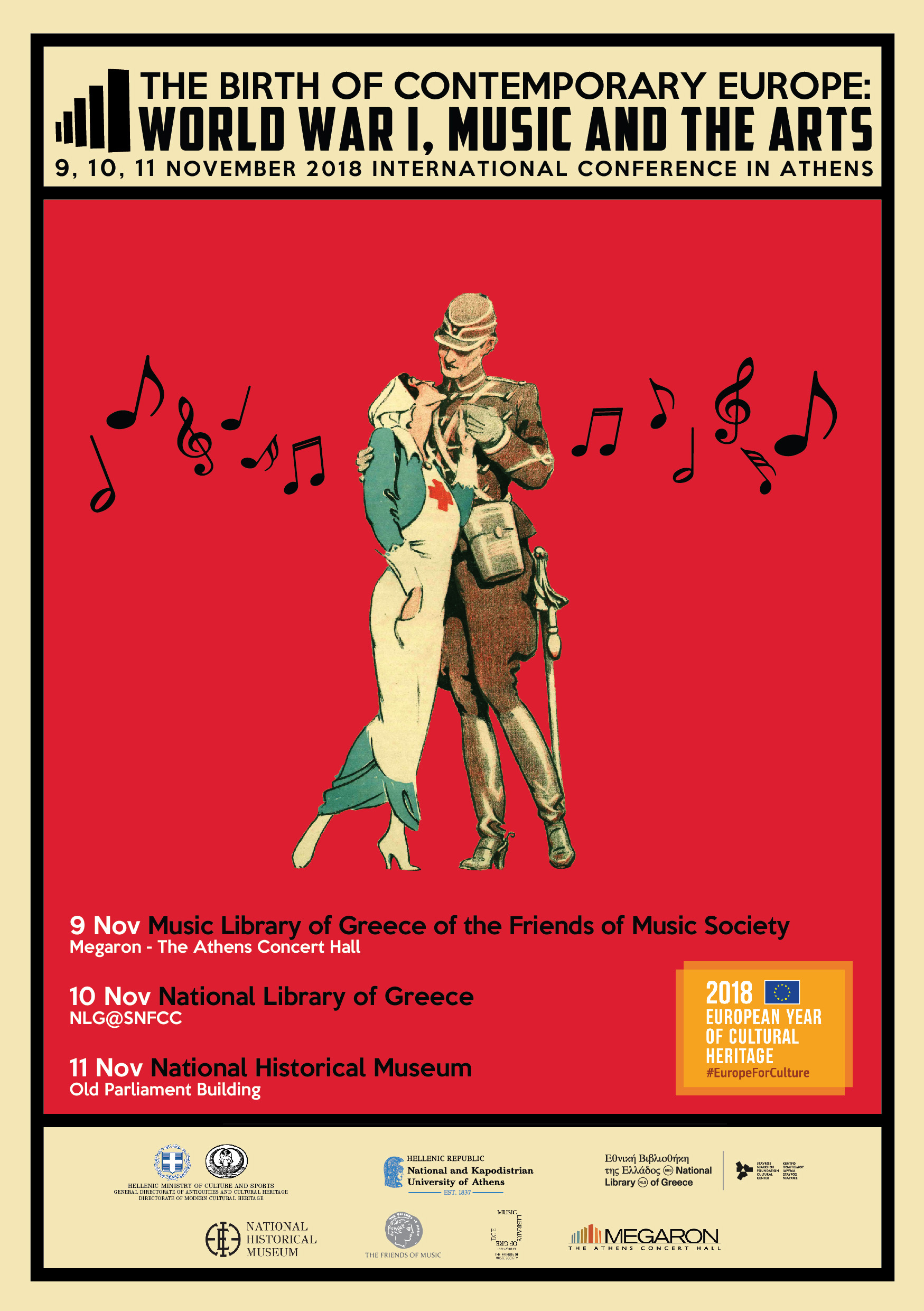
On November 9-11, 2018, an international conference entitled "The Birth of Contemporary Europe: World War I, Music and the Arts" was held.
World War I has been the turning point towards the birth of Contemporary Europe. It signaled the crucial end of the Empires and the shift towards new perspectives. The artistic and cultural output of the period in discussion has been rich and diverse, something that has been partially reflected on the scope of projects such as Europeana 1914-1918 , Europeana Migration and others.
In this international multidisciplinary conference, we expect to discuss several issues that have to do with artistic and cultural manifestations and their connection to music and sound in general, which occur both during, but also after, the end of the Great War.
Website & webserver administration: Tassos Kolydas. Design: Andreas Vakalios.
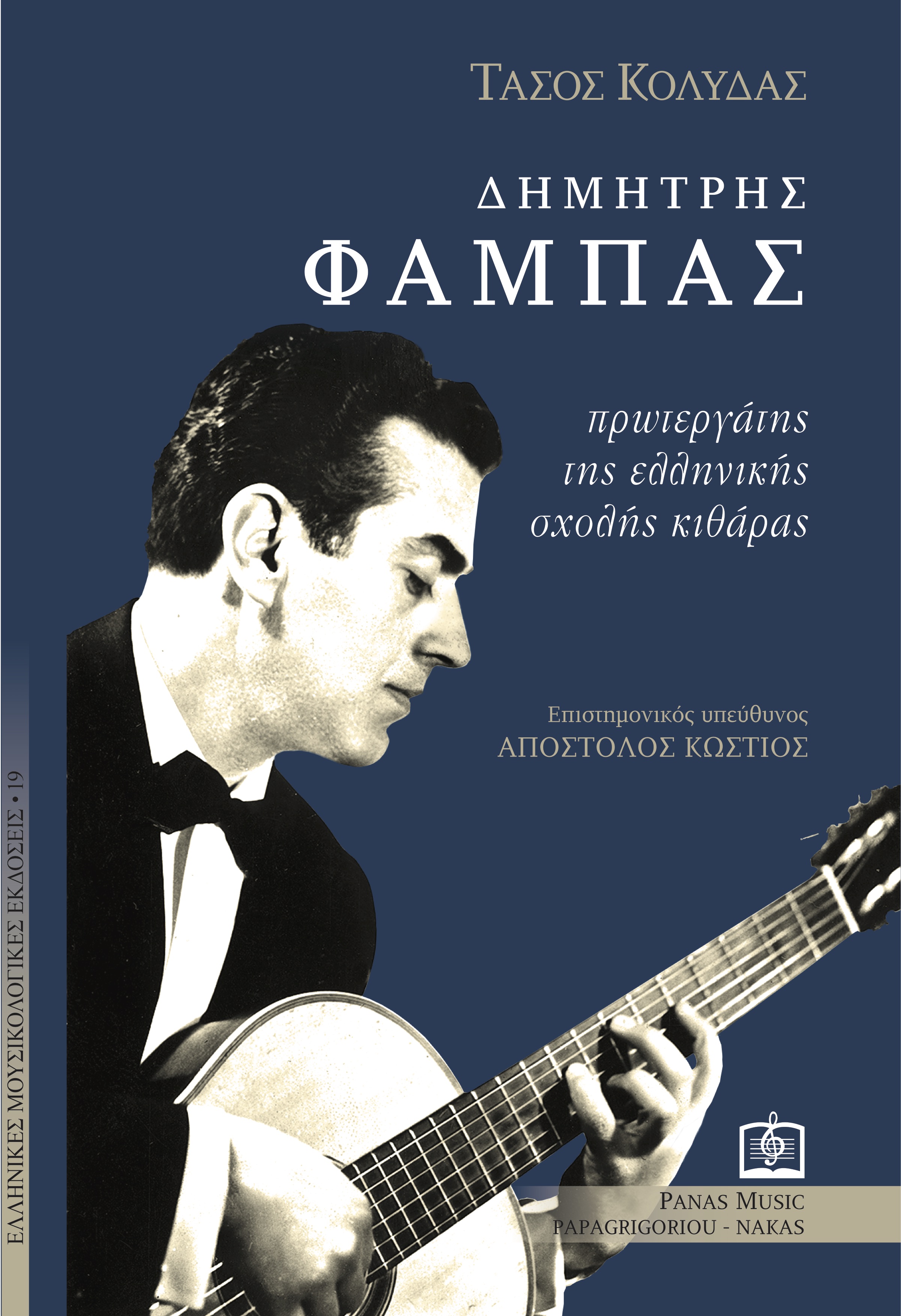 My book about the pioneer greek guitarist Dimitri Fampas (1921-1996) was published by Panas Music. Pages: 456. Dimensions 17x24cm. ISBN: 978-6-18-531302-9. My goal is to investigate an unknown area in the history of modern Greek music and in particular to explore the rapid increase of interest in classical guitar in the second half of the twentieth century in Greece. Also, to investigate the foundations and development conditions of the Greek guitar school, through the study of the life and work of Dimitris Fampas.
"Classical guitar in Greece in the second half of the twentieth century: aspects of the transformation of a musical instrument from the point of view of the repertoire", 9th Conference of Hellenic Musicological Society, Thessaloniki, 1.12.2017
 Tassos Kolydas is a member of the Laboratory-Teaching Staff of the Department of Music Studies of the National and Kapodistrian University of Athens. He has studied musicology (PhD), computer science (MSc), and guitar. He has published musicological and computer science papers in both Greek and international journals. He has presented papers on musicology and computer science at international conferences.
His teaching experience includes courses on history of music, guitar history in Europe, digital scores and electronic publications, and audio engineering. He has developed web applications for projects on digitising cultural collections on behalf of University of Athens, Greek National Opera, University of Ioannina and Institute of Research on Music and Acoustics. His research interests include Greek art music, Digital Management of Cultural Heritage and Information and Communication Technologies in Education.
A founding member of the musicological journal Polyphonia, he also serves as a member of its editorial committee. Kolydas has served as Executive Secretary of the Greek Music Council and Chairman of the Alumni of the Department of Music Studies of the University of Athens. He is a member of the Hellenic Musicological Society and the Greek Society for Music Education.
The phenomenon of music plagiarism and music plagiarism raises considerations of both artistic and legal nature. How does a musician experience plagiarism and how does he use his earlier works as a source of inspiration? When is the use of data from earlier projects permissible and when is it counterfeit under intellectual property law? What are the technical tools for verifying plagiarism and what do the musicological analyzes offer?
Zagori is a region endowed with rare natural beauty. Historical conditions have shaped a particular cultural environment there, where the multiplicity of small societies does not negate the unity of the whole. This is a real cultural heritage site not only for the already recorded but also for the living memory. It is therefore natural for Zagori to be one of the most popular destinations in Epirus but also a lively sphere of social interaction where tradition meets modernity in most fields, from economy to the most direct forms of sociality.
 Please wait...